Short answer: define the operating problem before comparing machines
Before you look at any spec sheet, write down the problem you’re actually solving: your volume pattern, your menu, your service model, and who’s going to run the thing day to day. Buyers who start with product comparisons tend to pick equipment that fits a brochure instead of their venue, and that mismatch shows up later as slow service, wasted counter space, or a system nobody wants to maintain. Work through venue and demand, menu complexity, service model, footprint and utilities, throughput, ownership, and economics in that order, then use TendedBar’s configuration options as one input to a decision you’ve already framed.
Step 1: document venue, dayparts, and demand pattern
Start with real numbers, not a general sense of “busy.” How many drinks do you serve on an average day, and what does your peak hour look like? Is demand steady across the day or concentrated in short bursts around game time, a conference session, or a lunch rush? A system that handles steady demand well may struggle with a 20 minute spike, and vice versa. Write down your daily volume, your peak hour volume, and how predictable that peak is before you talk to any vendor.
Step 2: define beverage categories and menu complexity
List every drink category you want the system to support: cocktails, mocktails, coffee drinks, teas, sodas, or something else. Then count how many distinct recipes that menu actually requires, and how often you expect the menu to change. A system that’s great for a fixed 10 item menu may not be the right fit for a program that rotates recipes seasonally. Menu complexity also drives ingredient input count, which affects both equipment selection and ongoing procurement.
Step 3: choose the service model and handoff
Decide whether staff will run the system as a production tool, guests will interact with it directly, or you’ll run some mix of both. This decision affects interface design, payment handling, staffing, and, where alcohol is involved, age verification requirements, which vary by municipality. Confirm what applies in your jurisdiction with TendedBar before finalizing a self-service or unattended alcohol model. Pick the service model before you evaluate hardware. The same machine can support different models, but not every configuration supports every model equally well.
Step 4: validate footprint, utilities, ingredients, and cooling
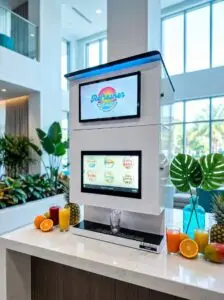
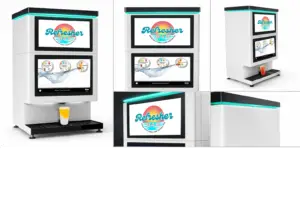
Once you know your service model, confirm the physical requirements. TendedBar’s countertop configuration runs roughly 30 in W x 25.5 in D and draws on a standard 20-amp, 110V circuit in most applications, though full system electrical requirements should always be confirmed with a licensed electrician before you commit to a location. [CONFIRM: current footprint and utility requirements for larger multi-station or dual-screen configurations before publishing specific dimensions for those products.] Plan for ingredient storage, CO2 tanks, cooling equipment, and technician service access on top of the base footprint.
Step 5: evaluate throughput using comparable tests
Ask vendors for throughput figures tied to a specific configuration and test method, not a general marketing number. TendedBar systems pour in as little as 5 seconds per drink under standard conditions. When comparing vendors, confirm whether a competing number reflects sustained service or a brief peak burst, and whether it includes the guest’s full wait, not just the pour itself. [CONFIRM: approved multi-station and sustained throughput figures before citing specific numbers beyond the countertop pour-time claim.]
Step 6: assign cleaning, restock, monitoring, and support ownership
Decide who owns cleaning cycles, ingredient restocking, error monitoring, and support escalation before you sign anything. This is one of the most commonly skipped steps in a buying process, and it’s also one of the biggest drivers of whether automation actually performs well once it’s installed. A great machine with no clear owner for these tasks will underperform regardless of its specs.
Step 7: model economics and pilot success criteria
Build a simple model of your expected costs and benefits using your own volume, labor, and waste data rather than vendor-supplied percentages. If you’re running a pilot, decide up front what you’ll measure (drink volume, labor hours, waste, guest wait time) and what result would justify a full rollout. [CONFIRM: current TendedBar commercial terms, warranty, and support model before including specific pricing or SLA language in buyer-facing content.]
How TendedBar’s configuration families map to common scenarios
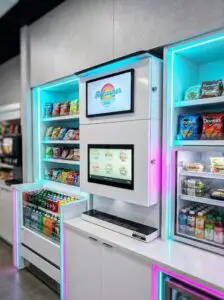
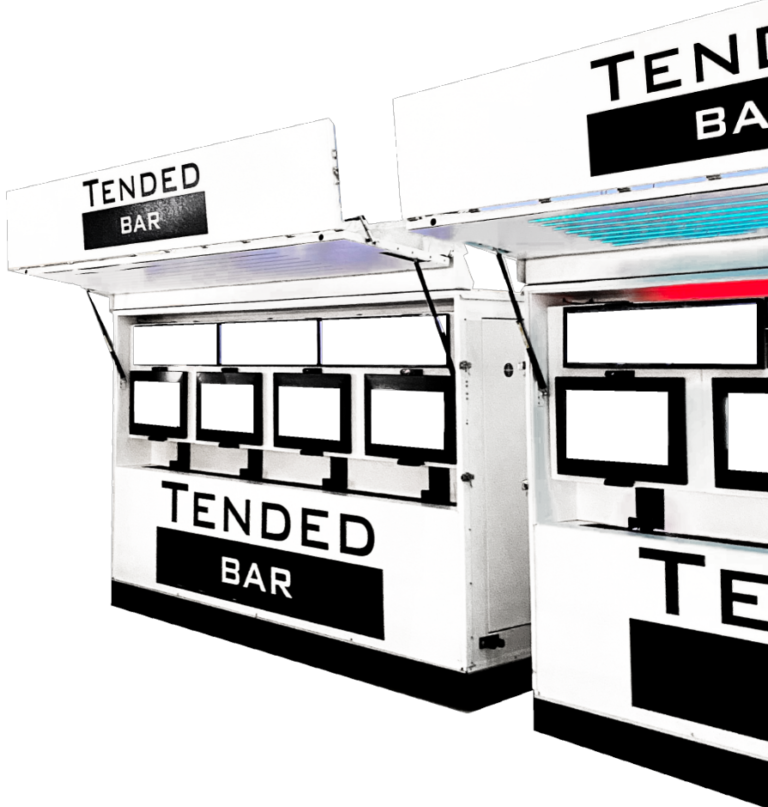
TendedBar’s countertop configuration is built for flexible, everyday production in restaurants, hotels, cafes, convenience stores, and concessions, with confirmed specs of roughly 30 in W x 25.5 in D, up to 16 BIB and 10 bulk ingredient inputs, and standard 20-amp/110V power in most applications. For higher volume or multi-point service, TendedBar also offers larger and mobile configurations for events and distributed venues. [CONFIRM: current specifications, capacities, and public availability status for four-station and dual-screen configurations before publishing a direct comparison.] Ask your TendedBar contact which configuration fits your specific volume and layout as part of a system assessment.
Automated beverage system shortlist checklist
- Documented daily and peak-hour drink volume, including how predictable that peak is
- Defined beverage categories and menu complexity, mapped to required ingredient inputs
- Chosen service model (staff-run, guest self-service, or a mix), with age verification rules confirmed if alcohol is on the menu
- Confirmed footprint, utilities, and ingredient storage needs for your specific configuration
- Throughput figures tied to a specific configuration and test method, not a general marketing claim
- Assigned ownership for cleaning, restocking, monitoring, and support before go-live
- A cost and benefit model built on your own data, with clear pilot success criteria if you’re testing first
Frequently Asked Questions
Which beverage-system configuration is best for a small venue?
It depends on your volume and menu, not just your square footage. TendedBar’s countertop configuration (roughly 30 in W x 25.5 in D) is built for flexible, everyday production and fits many smaller footprints, but the right configuration for you depends on your specific service model and demand pattern. Talk to TendedBar about a system assessment before assuming a single configuration fits your venue.
How much volume justifies beverage automation?
There’s no universal threshold. Venues with predictable high-volume stretches, like game days or conference sessions, tend to see the clearest case, since a single well-configured system can generate the throughput that would otherwise take four or more additional staff to match. Lower and steadier volume can still justify automation for consistency and portion control reasons, so document your own numbers before ruling it in or out.
What site information do vendors need to recommend equipment?
At minimum, your expected volume, menu, service model, available counter or floor space, and existing utilities. The more specific you can be about peak demand and menu complexity, the more accurate a vendor’s recommendation will be.
Should we start with a pilot?
A pilot can be a useful way to validate throughput, guest response, and operational fit before a full rollout, especially for a new service model or an unfamiliar venue type. Decide what you’ll measure and what result would justify scaling up before you start.
How should we compare vendor throughput claims?
Ask for a pour time or throughput figure tied to a specific, current configuration, and confirm whether it reflects sustained service or a brief peak burst. TendedBar systems pour in as little as 5 seconds per drink; ask any competing vendor for the same level of detail before comparing numbers directly.
Who should participate in the buying decision?
Procurement, facilities, IT, finance, and the operations team that will actually run the equipment day to day all have a stake in this decision. Leaving any one of these groups out tends to surface problems after the equipment is already installed.