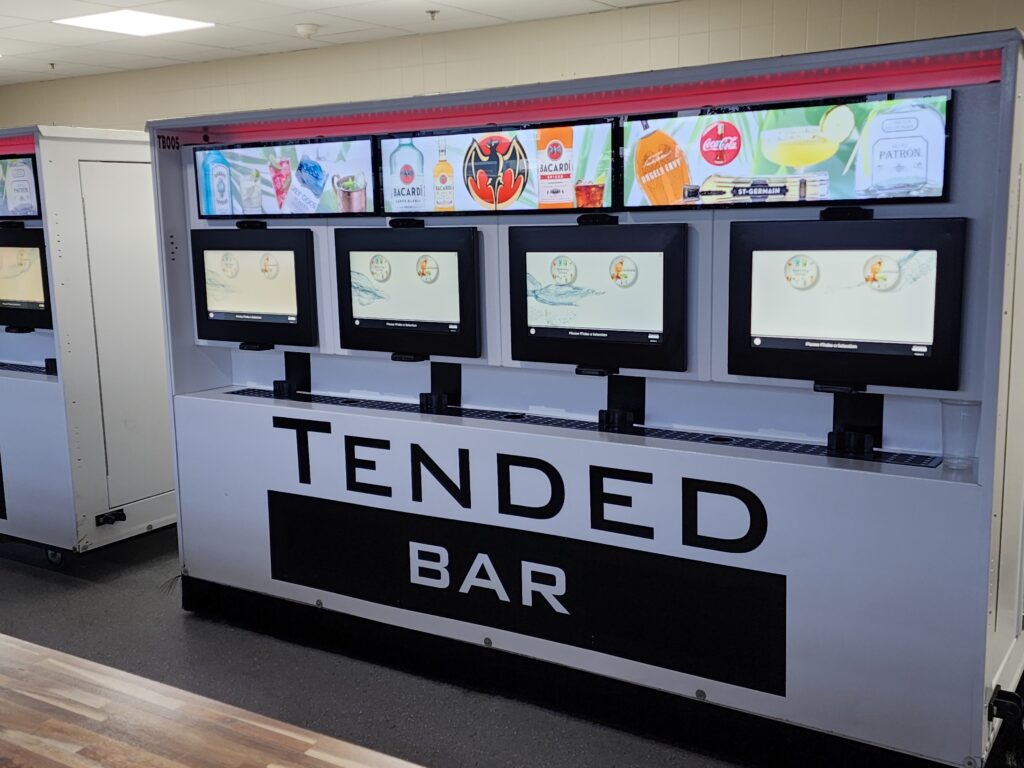
The Short Answer
A good commercial countertop beverage dispenser fits the job it needs to do: back-of-house production, crew-serve handoff, or guest self-service within your available counter space, utilities, and staffing model. TendedBar’s countertop configuration runs about 30 in W x 25.5 in D and supports up to 16 BIB and 10 bulk ingredient inputs, drawing on a standard 20-amp, 110V circuit in most applications. Before comparing machines, map your menu and ingredient needs, real footprint and clearances, and who’s going to own cleaning and restocking.
Start with the job the system must perform
Before you get into spec sheets, figure out how the machine will actually be used in your operation. The same piece of equipment can be deployed very differently depending on the service model built around it.
Back-of-house production
The system works as a production tool for staff, out of guest view, and the drinks it produces get delivered as part of normal service.
Crew-serve handoff
Staff select and dispense drinks right in front of or near the guest, pairing the speed of automation with a staffed handoff and quality check.
Guest self-service or unattended service
Guests interact with the interface directly, and staffing gets reduced or removed from the immediate transaction. This puts more weight on interface design, payment handling, and, where alcohol is involved, identity verification. Age-verification requirements vary by municipality, so confirm what your local rules require before assuming a self-service alcohol model is available to you.
Evaluate the menu and ingredient architecture
The ingredient system behind a countertop dispenser determines what it can actually produce and how it needs to be restocked.
BIB inputs
Bag-in-box (BIB) inputs handle syrups and similar concentrates. TendedBar’s countertop configuration supports up to 16 BIB inputs.
Bulk liquid inputs
Bulk inputs are used for ingredients stored and fed in larger volume. TendedBar’s countertop configuration supports up to 10 bulk inputs.
Carbonation, water, and ice
Depending on the menu, the system may need a carbonation source, a filtered water line, or an ice supply. Each one carries its own utility and maintenance implications, so plan for them at install rather than discovering them afterward.
Recipe count versus ingredient count
A higher number of stored recipes doesn’t necessarily need a proportionally higher number of physical inputs. A lot of recipes share base ingredients. When comparing systems, ask how many physical inputs are actually required to support the menu you want, not just the maximum recipe count a vendor advertises.
Confirm the real footprint and service clearances
Counter space
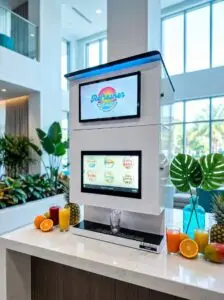
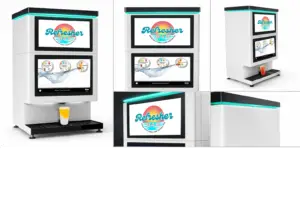
TendedBar’s countertop unit measures roughly 30 in W x 25.5 in D. Measure your counter run against that before assuming it fits.
Ingredient and CO₂ storage
Counter footprint is only part of the space equation. BIB boxes, bulk containers, and CO₂ tanks typically need nearby storage, which should be part of the layout plan, not an afterthought.
Ventilation and technician access
Confirm any ventilation requirements for your configuration, and leave enough clearance for a technician to service the unit without tearing down the whole station around it.
Document utilities before selecting equipment
Power
Most TendedBar countertop applications run on a standard 20-amp, 110V circuit. Confirm the exact electrical requirement for your full installed system with a licensed electrician before committing to a location. Don’t rely on a single component’s spec as the system-level requirement.
Water and drainage
Some configurations need a water line and drain; others don’t. Confirm this for your specific setup before finalizing the installation site.
Cooling configuration
Cooling can be handled a few different ways depending on the system. Confirm which configuration applies to your unit and what it needs in terms of space, drainage, and ventilation.
Network connectivity
If you’re planning remote monitoring, POS integration, or cashless payment, confirm the network requirements and which integrations are currently supported for your configuration. Don’t assume a system connects with every POS platform without confirming compatibility directly.
Plan cleaning, restocking, training, and maintenance
A countertop dispenser is only as reliable as the operational plan around it. Before installation, nail down the cleaning cycle and schedule, who restocks BIB/bulk ingredients and CO₂, what training staff get, and how service requests get handled.
Compare commercial terms and operating responsibility
Beyond the equipment itself, compare purchase versus lease/service terms, what’s covered under warranty or a service agreement, expected support response times, and who owns consumables and replacement parts over the life of the equipment.
Where the TendedBar countertop configuration fits
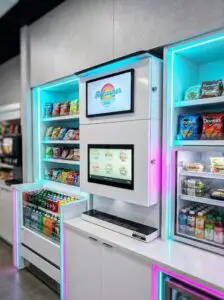
TendedBar’s countertop configuration (30 in W x 25.5 in D, up to 16 BIB and 10 bulk inputs, standard 20-amp/110V power) is built for flexible, everyday beverage production (restaurants, hotels, cafés, convenience stores, and concessions), rather than one narrow use case. One system can generate the throughput of four or more additional staff during peak periods, with pours in as little as 5 seconds each.
Countertop beverage dispenser evaluation checklist
- Confirmed footprint (roughly 30 in W x 25.5 in D for TendedBar’s countertop unit) fits the counter space, with room for ingredient storage nearby
- Menu mapped to actual BIB/bulk ingredient inputs required (up to 16 BIB / 10 bulk for TendedBar’s configuration)
- Utilities confirmed: standard power (20A/110V in most applications), water/drain if needed, network
- Cleaning and restocking ownership assigned before go-live
- Support/service terms and response times understood
- Age-verification and compliance requirements confirmed for your municipality if alcohol is on the menu
Frequently Asked Questions
What can a countertop beverage dispenser make?
That depends on the configuration’s ingredient inputs and plumbing. TendedBar’s countertop unit supports up to 16 BIB and 10 bulk inputs across a wide range of recipes. Confirm the current menu capability for your exact configuration.
How much counter space does a commercial dispenser require?
TendedBar’s countertop unit measures roughly 30 in W x 25.5 in D. Plan for nearby ingredient and CO₂ storage in addition to that footprint.
Does a countertop beverage system need plumbing?
Some configurations need a water line and drain; others don’t. Confirm this for your specific system and menu before finalizing your installation site.
Where are ingredients stored?
BIB boxes, bulk containers, and CO₂ are typically stored near the unit, either in a base cabinet or in an adjacent storage area, depending on the installation.
Can one machine serve cocktails and non-alcoholic drinks?
Yes, TendedBar configurations support both, though alcohol service is subject to local age-verification rules, which vary by municipality. Reach out to TendedBar to confirm what applies to your location.
How is a countertop beverage dispenser cleaned?
Cleaning cycles and schedules are configuration-specific. Confirm the recommended process and frequency as part of your evaluation, and assign clear ownership for the task before go-live.