Anyone who has tried to get a decent drink on a long train ride knows the usual result: a cart with a narrow selection, a card reader that may or may not work, and a wait that eats into the trip. The constraint isn’t demand, people traveling for hours are a captive, willing market, it’s that a rail car has almost none of the infrastructure a bar normally assumes.
Power is the ceiling, not the floor space
A café car or bar car usually has room to spare compared to something like a food truck, but what it typically doesn’t have is a dedicated high-amperage circuit sitting unused. Rail cars run lighting, HVAC, and increasingly onboard WiFi off a shared electrical budget, and any beverage equipment added has to fit inside whatever capacity is left over, not the other way around. That’s close to the opposite of a stadium concession stand, where power is plentiful and square footage is the scarce resource.
There’s no plumbing car
Fixed water and drain hookups exist at some bar cars, but most rolling stock doesn’t have them, and even where they exist, servicing a line mid-route isn’t realistic. Equipment that depends on a direct water connection is a non-starter for most rail applications. What actually works runs on bag-in-box or bulk containers restocked at a terminal, the same basic model used for galley carts on aircraft.
Vibration and motion rule out anything fragile
A train moving at speed jolts and vibrates in ways a stationary bar never has to plan around, and loose glass, exposed mixing components, or anything not firmly secured turns into a hazard rather than a nuisance. Equipment considered for rail service needs to be rated and mounted for that environment specifically, it isn’t a detail to work out after installation.
Where it actually makes sense
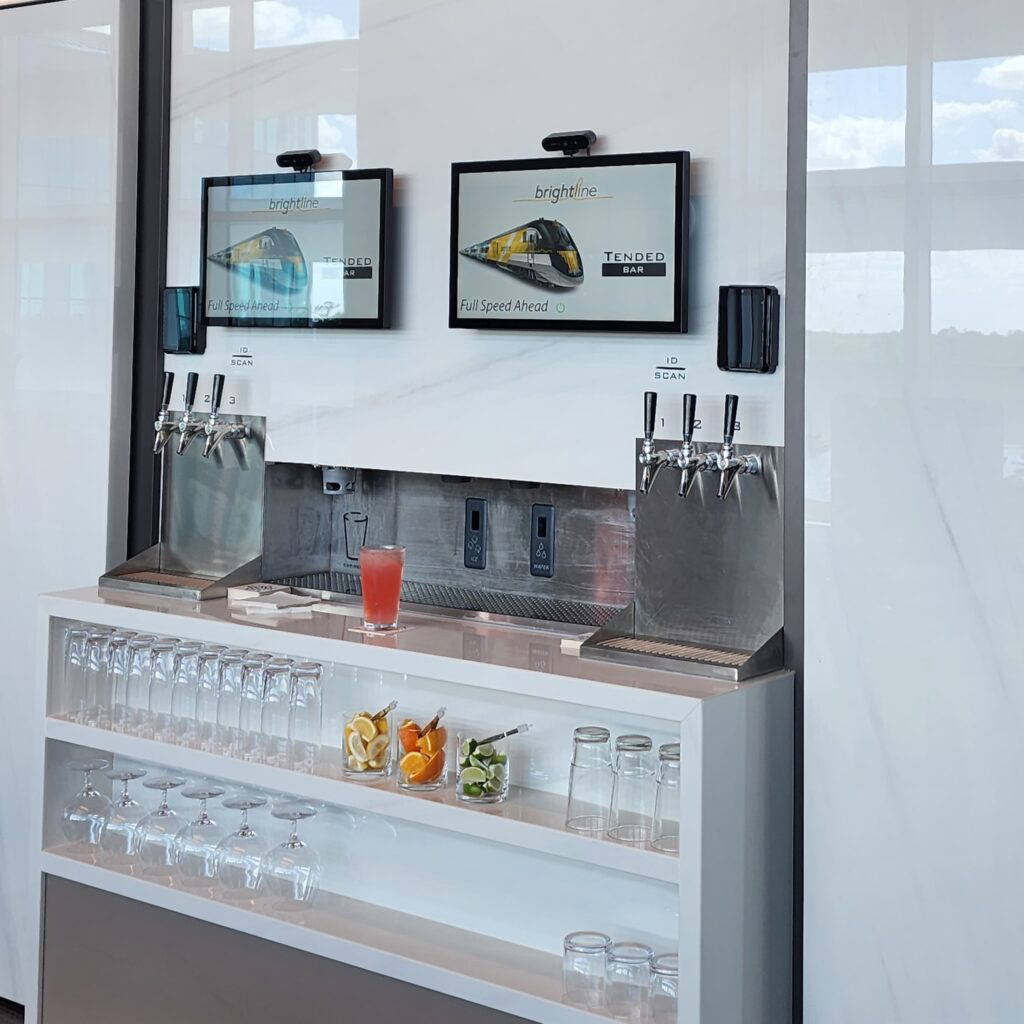
Long-haul routes with a dedicated café or bar car, where the ride runs for hours rather than minutes, are the realistic use case, not commuter rail where most trips are under thirty minutes and beverage service was never the point of the journey. On longer routes, a compact automated station can free the one attendant typically staffing the car to focus on food service and payment issues instead of mixing every drink by hand for the length of the route. For an operator actually evaluating this, three questions tend to decide whether it’s workable: how much unused electrical capacity exists on that specific rolling stock, how equipment gets restocked given the route’s terminal schedule, and whether the car has been rated to carry foodservice equipment in the first place.