The Short Answer
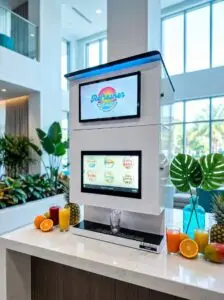
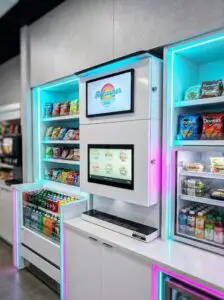
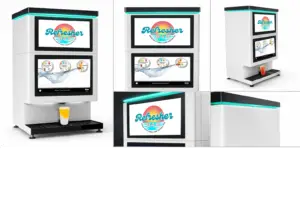
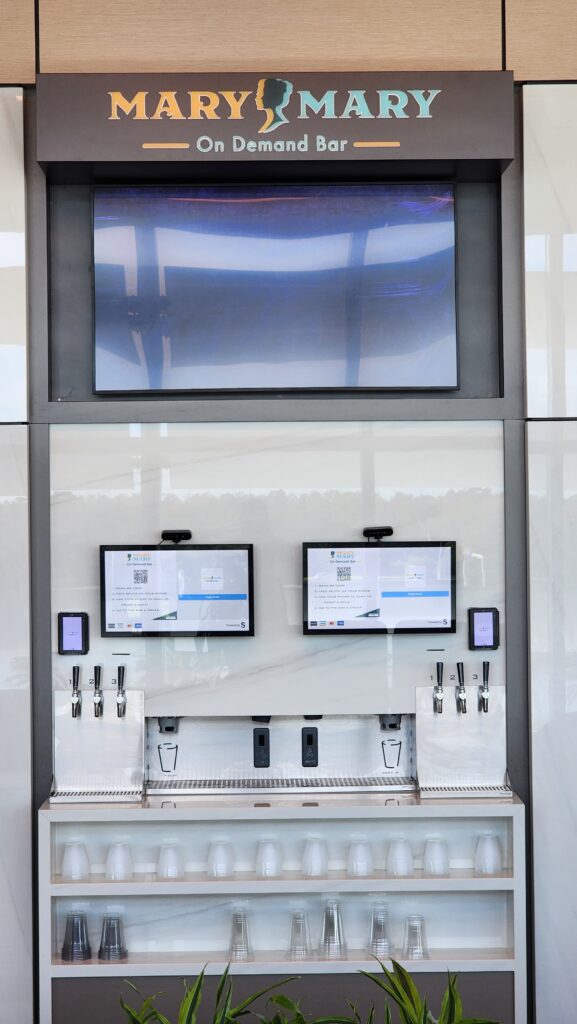
A commercial automated beverage dispenser mixes and pours a drink to a set recipe on demand, taking over some or all of the manual steps a bartender or crew member would otherwise handle. It covers everything from carbonated soft drinks to full cocktails depending on configuration, pouring in as little as 5 seconds per drink, and can be run by staff, by guests, or with limited attendance. Whether it makes sense for your operation comes down to your volume, menu, footprint, and who’s going to own cleaning and restocking, not just the equipment itself.
How an automated beverage system works from order to handoff
Most commercial beverage automation systems follow a similar sequence, even though the interface and hardware differ a lot between platforms. Knowing each step helps you tell what a vendor is actually offering apart from what’s just marketing copy.
Order or selection
A drink gets selected either by a staff member on a touchscreen or button panel, or directly by a guest through a self-service interface. Some systems tie into a point-of-sale (POS) system so the order fires automatically; others are stand-alone and need a manual selection.
Ingredient measurement and mixing
Once a recipe is selected, the system doses each ingredient (syrups, juices, spirits, or other components according to a stored formula. This is portion control at its core: the same drink comes out the same way every time, no matter who (or whether anyone) is running the machine that shift.
Cooling, carbonation, and cup handoff
Depending on the menu, the system may chill ingredients, add carbonation, or dispense over ice before handoff. That handoff can go to a staff member for guest delivery, straight to a guest at a self-service station, or into a queue for pickup.
Data and monitoring
Many systems log pour counts, ingredient levels, and error states, so operators get visibility into consumption and maintenance needs without manual inventory counts. How deep that reporting goes varies a lot by vendor and configuration.
How it differs from a soda fountain, self-pour tap wall, and vending machine
These categories get confused often enough that it’s worth separating them:
- Soda fountain: limited to carbonated soft drinks with fixed syrup lines and no real recipe automation beyond flavor selection.
- Self-pour tap wall: guest-controlled taps, most often used for beer, wine, and cocktails on tap, usually metered by volume or time rather than a built recipe.
- Vending machine: a packaged-goods dispenser (cans, bottles) with no mixing or recipe function at all.
- Automated beverage dispenser: builds a drink to a recipe from component ingredients. That’s the line that separates it from the three above.
Which beverage categories and service models can be automated?
Automation isn’t limited to one beverage category. What a given system can actually produce depends on its specific configuration (ingredient inputs, plumbing, software), so treat any vendor’s beverage list as configuration-specific, not universal.
Crew-serve and back-of-house
Staff selects and produces drinks using the system as a production tool, and guests never touch the machine directly. This keeps a person in the workflow for quality control and guest service while still picking up consistency and speed.
Guest self-service
Guests interact with the system directly, typically through a touchscreen, to select and receive their own drink. This shifts more of the interface, payment, and identity-verification design onto the equipment and whatever it’s integrated with.
Semi-attended and unattended
Some deployments combine self-service with limited or no on-site staff oversight. Availability of unattended operation, especially for alcoholic beverages, depends heavily on the configuration and the local jurisdiction. Age-verification requirements vary by municipality, so never assume unattended alcohol service is allowed at a given location without confirming the specifics for that market.
When beverage automation makes operational sense
Recurring volume or peak demand
Venues with predictable high-volume stretches (game days, conference sessions, festival hours) tend to see the clearest case for automation. A single well-configured system can produce the throughput that would otherwise take four or more additional staff to match, which is where the labor math starts to work in automation’s favor.
Menu consistency and portion control
Operators running multiple locations or shifts get a system that pours the same drink the same way regardless of who’s on shift, which also makes ingredient costing more predictable.
Small footprints or distributed service
Locations without room for a full bar setup (kiosks, concession stands, satellite service points) can offer a broader beverage menu than the physical space would otherwise allow.
A defined owner for cleaning, ingredients, and uptime
Automation doesn’t remove the need for operational ownership. Someone still has to restock ingredients, run cleaning cycles, and respond when the system flags an error. Venues without a clear owner for these tasks tend to see automation underperform no matter how good the hardware is.
When automation is probably not the right answer
Automation isn’t a fit for every beverage program. It tends to underperform when the menu changes too often for recipe-based systems to keep up, when volume is too low to justify the equipment and maintenance overhead, when the program depends on visible bartender craft as part of the guest experience, or when there’s no realistic plan for who owns day-to-day maintenance. Sorting through these up front avoids a costly mismatch later.
Where TendedBar fits
TendedBar builds beverage automation systems that span multiple operating models rather than one fixed configuration, so operators can match the platform to their actual venue and menu instead of forcing a one-size-fits-all machine into place.
Countertop and crew-serve applications
TendedBar’s countertop configuration is built to fit into an existing back-of-house or crew-serve workflow, with a footprint of roughly 30 in W x 25.5 in D, small enough to sit on a standard counter run without a dedicated bar build-out. It’s designed for consistent daily-use production, not a single narrow occasion.
Larger multi-station and mobile applications
For higher-volume or multi-point service, TendedBar also supports larger and mobile configurations for events and distributed venues. Ask your TendedBar contact which configuration best fits your specific volume and layout. This is one of the first things to confirm during a system assessment.
Alcoholic and non-alcoholic programs
TendedBar systems are used across both alcoholic and non-alcoholic beverage programs. Because age-verification and service-mode rules vary by municipality, reach out to TendedBar to learn what applies in your specific location before finalizing a service model.
Questions to answer before requesting a system assessment
- What’s your expected daily and peak-hour drink volume?
- How many distinct recipes or menu items does the system need to support?
- What service model do you want: staff-run, guest self-service, or a mix?
- What counter or floor space is realistically available, including ingredient storage?
- What utilities (power, water, drainage, network) are already in place at the install location?
- Who on your team will own cleaning, restocking, and day-to-day troubleshooting?
Frequently Asked Questions
Is an automated beverage dispenser the same as a soda fountain?
No. A soda fountain is limited to carbonated soft drinks with fixed syrup lines. An automated beverage dispenser builds a drink from a stored recipe and can span a much wider range of beverage categories depending on its configuration.
Can automated beverage systems make both alcoholic and non-alcoholic drinks?
Yes, some systems are configured to handle both, though availability depends on the hardware configuration, ingredient plumbing, and local alcohol-service regulations. Age-verification rules vary by municipality, so confirm what applies to your location before finalizing a program.
Does beverage automation eliminate bartenders or crew members?
Not necessarily. Many operators keep staff in the workflow for quality control, guest service, and exception handling, and use automation to boost consistency and speed rather than remove the role outright. The right operating model depends on your service goals.
How much space does a commercial automated beverage system need?
It depends on the configuration. TendedBar’s countertop unit measures roughly 30 in W x 25.5 in D, and larger multi-station setups require more space. Either way, plan for ingredient and CO₂ storage, ventilation, and technician access on top of the footprint itself.
What utilities does an automated beverage dispenser require?
Most TendedBar applications need a standard 20-amp, 110V circuit. Some configurations also require water and drainage, or network connectivity for monitoring or POS integration. Confirm the specifics for your configuration before installation.
How should buyers compare vendor throughput claims?
Ask for a pour-time figure tied to a specific, current configuration rather than a general marketing number. TendedBar systems pour in as little as 5 seconds per drink; confirm whether a competing figure reflects sustained service or just a brief peak burst.