The Short Answer
Staff-serve, self-service, semi-attended, and unattended are different operating models built on similar underlying hardware. The model you choose changes staffing, interface design, payment and identity handling, compliance obligations, and support requirements far more than the machine itself does. Pick the operating model that fits your guest flow, compliance environment, and staffing plan first, then select equipment that supports it. Availability of any given mode depends on configuration, beverage type, and local jurisdiction. Age-verification rules in particular vary by municipality.
What staff-serve and back-of-house beverage automation look like
In staff-serve and back-of-house models, automation operates behind the scenes as a production tool, while a staff member remains in the workflow the entire time.
Who selects the recipe?
A staff member selects the drink on the system’s interface, whether manually or via a POS integration.
Who handles the cup and garnish?
Staff typically handle cup placement, garnish, and any finishing steps the automated system doesn’t do itself.
Who owns exceptions
When something goes wrong an empty ingredient, a jammed pour, a guest asking for a substitution a staff member is right there to fix it, which is one of the main operational advantages of this model.
What guest self-service changes
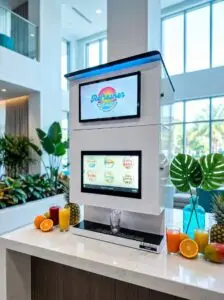
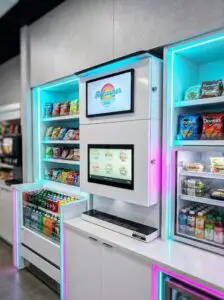
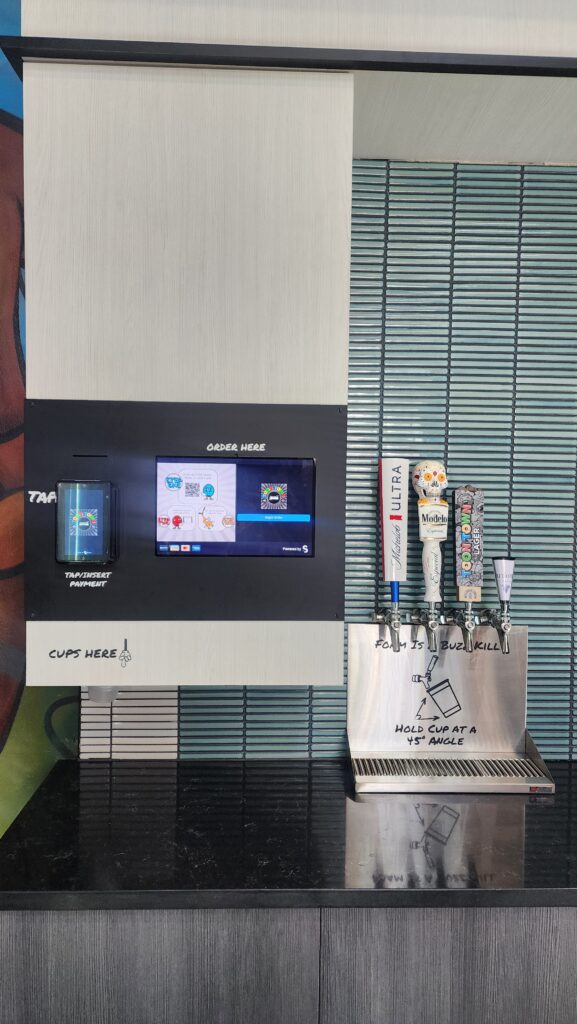
Moving to guest self-service shifts several responsibilities from staff to the equipment and its supporting systems.
Interface and payment
The guest-facing interface has to be simple enough for someone unfamiliar to use correctly, and payment has to be handled by the system itself rather than a staff member at a register. Confirm current payment and identity-verification methods with TendedBar before publishing or promising specific options.
Cup control and handoff
Systems need a defined way to prevent overfilling, contamination, or misuse without requiring a staff member to watch every pour.
Staff oversight
Even in self-service settings, most deployments maintain some staff presence nearby for restocking, troubleshooting, and guest assistance. The difference from staff-serve is proximity and involvement per transaction, not necessarily zero staffing.
What unattended beverage service requires
Unattended operation is the most demanding model to run responsibly, since there’s no staff member present to catch problems as they happen.
Remote monitoring
Operators generally need reliable remote visibility into ingredient levels, error states, and machine status so problems get addressed before they affect guests.
Restock ownership
Someone still has to own a restocking schedule and route for unattended locations. Automation doesn’t remove that responsibility. It just moves it off-site.
Failure states and guest support
Plan for what happens when the system fails while unattended: how a guest gets help or a refund, and how quickly staff can respond. This is one of the most commonly underestimated parts of unattended deployments.
A note on alcohol and unattended service: Unattended service of alcoholic beverages isn’t universally lawful. It depends on local and state regulations, licensing, and the specific compliance controls built into a given configuration, and age-verification requirements vary by municipality. Reach out to TendedBar to learn what applies to your specific location, and never assume unattended alcohol service is permitted without confirming with local authorities and your own legal counsel.
How beverage type changes the operating model
Non-alcoholic drinks
Non-alcoholic beverage programs generally face fewer regulatory constraints, which is part of why self-service and unattended models are more common in these menus.
Alcoholic drinks
Alcoholic beverage programs carry licensing, age-verification, and service-mode restrictions that vary by state and municipality. Reach out to TendedBar to learn what applies to your specific location before publishing or promising any specific alcohol self-service capability.
Dairy and perishable ingredients
Menus that include dairy or other perishables add food-safety considerations temperature control, shelf life, and cleaning frequency that should factor into your choice of operating model and maintenance plan.
Comparison: staffing, throughput, compliance, footprint, and experience
- Staffing: highest in staff-serve, lowest in unattended, though unattended still needs restocking and monitoring labor, just not per-transaction. A single well-run system can cover the throughput of four or more additional staff.
- Throughput: depends heavily on interface design and guest familiarity, not just the operating model. Pours can run as little as 5 seconds each once a guest knows the interface.
- Compliance: gets more complex moving from staff-serve through unattended, especially for alcoholic programs.
- Footprint: self-service and unattended models often need extra space for guest queuing and interface access that staff-serve back-of-house setups don’t.
- Guest experience: staff-serve keeps a service touchpoint; self-service and unattended trade that for speed and availability outside staffed hours.
Where TendedBar configurations may fit
TendedBar’s platform supports staff-serve, self-service, and, where configuration and local compliance requirements allow, more limited-attendance models. Which specific configuration fits your operating model depends on your beverage program and jurisdiction, so talk to TendedBar directly about a configuration-by-mode fit for your venue.
Decision questions for operators
- What level of staffing do you realistically have at this location?
- Does your beverage program include alcohol, and what does your local jurisdiction require for that service mode?
- Who will own remote monitoring and restocking if you move toward self-service or unattended?
- What’s your plan for guest support if the system fails when unattended?
- Does your menu include dairy or other perishables that add food-safety requirements?
Frequently Asked Questions
What is the difference between staff-serve and self-service beverage automation?
In staff-serve, a staff member selects and produces the drink; in self-service, the guest interacts with the system directly. Both can run on similar underlying equipment, but staffing, interface, and oversight requirements differ significantly.
Can an automated alcohol system operate unattended?
It depends entirely on the specific configuration and local/state alcohol-service regulations. It isn’t universally lawful, and age-verification requirements vary by municipality. Reach out to TendedBar to learn what applies to your location, and confirm with local authorities and legal counsel before assuming it’s permitted.
Which service model is fastest?
Speed depends more on interface design and guest familiarity than on the operating model alone. TendedBar systems can pour in as little as 5 seconds; staff-serve and self-service can each be faster depending on execution and guest volume.
Does self-service always reduce labor?
Not necessarily. Self-service and unattended models still require restocking, monitoring, and support labor; it just shifts when and how that labor is needed, rather than eliminating it. That said, a single system can often generate the throughput of four or more additional staff during peak periods.
Who is responsible for cleaning and restocking an unattended system?
Someone on the operator’s team or a designated service partner must own a defined restocking and cleaning schedule for any unattended location. That responsibility doesn’t go away with automation.
Can the same equipment support more than one service model?
Some configurations can be adapted across operating models. Confirm the specific configuration-by-mode availability for your equipment with TendedBar before planning a service model around that assumption.