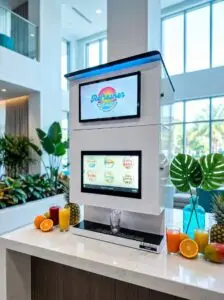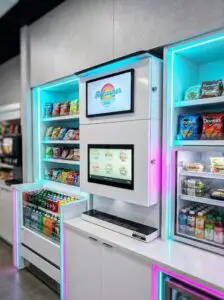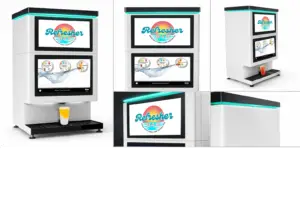
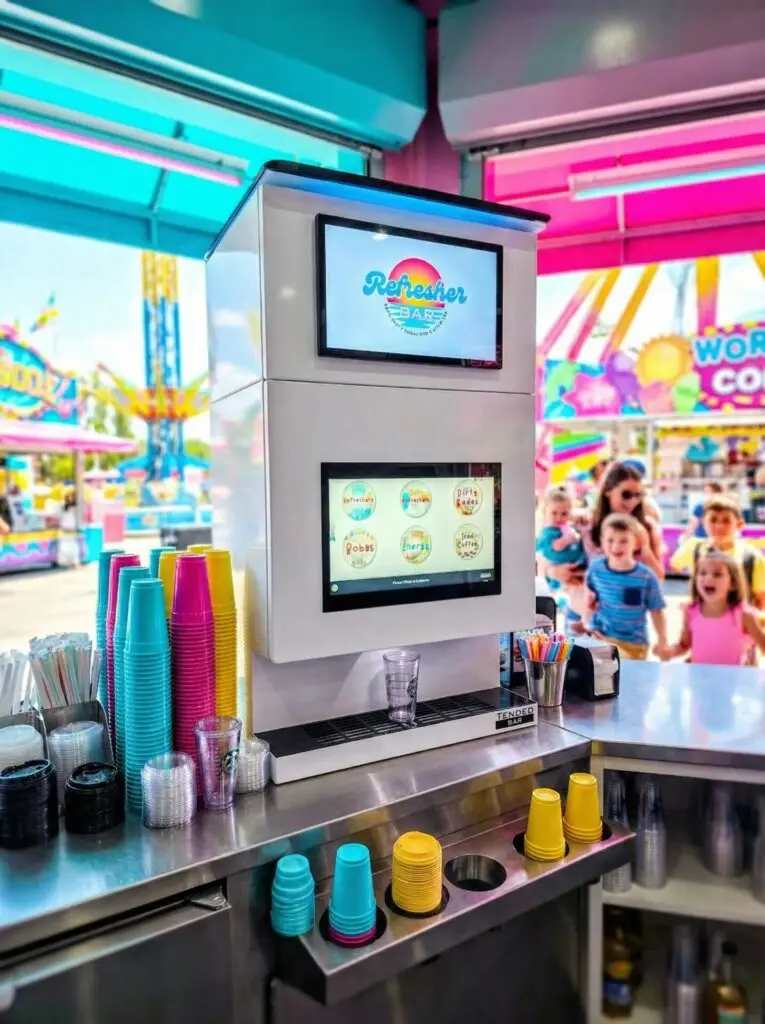
A festival bar has to solve problems a permanent venue never thinks about: where the power actually comes from, what happens when it rains, and how to serve a crowd that shows up over twenty minutes instead of trickling in over a full afternoon. None of that is about the drinks themselves, it’s about running a bar in a field that had no infrastructure a week ago and will have none again a week from now.
Temporary power is the first design constraint
Most festival grounds run on generators and distributed power that’s carefully budgeted across sound, lighting, vendor stalls, and every bar on site. Equipment that draws more than its allotted circuit can handle doesn’t just underperform, it can trip a line that other vendors depend on. Anything brought in has to be sized to a known, fixed power draw that the festival’s electrical plan can account for in advance, not figured out on site.
Weatherproofing isn’t optional, it’s the baseline
A stadium concession stand is under a roof. A festival bar usually isn’t, or is under a tent that doesn’t fully block wind-driven rain. Equipment that would be fine in a climate-controlled venue needs a real weather rating for outdoor festival use, and dust, humidity, and temperature swings across a multi-day event all take a toll that indoor equipment was never designed to handle.
The wave problem: everyone arrives at once
Festival crowds don’t spread out evenly, they move in waves tied to set times, gates opening, and the walk between stages. A bar near a stage can go from empty to a hundred-deep line in the ten minutes after a set ends. This is a more extreme version of the concession-line rush at a theater or stadium, but compressed into a shorter, less predictable window, and often without the staffing flexibility a fixed venue has to call in more bartenders on short notice.
Cashless and RFID change what “fast” actually means
Most major festivals have moved to RFID wristbands or cashless payment specifically because cash handling slows a line down more than almost anything else. Once payment friction is mostly solved, the pour itself becomes the next bottleneck, and that’s usually where an automated station earns its keep, keeping the physical drink-making step in sync with a payment system that’s already fast.
Common questions
Does this replace the need for a licensed bartender on site?
No. Alcohol service still requires whatever licensing, ID checks, and staff certification the event and local jurisdiction require, that responsibility doesn’t move just because the pour is automated.
How does equipment hold up across a multi-day event with different daily attendance?
It depends on restocking logistics more than the equipment itself, festivals typically plan BIB and bulk ingredient restocks around each day’s projected attendance, and a compact automated unit is easier to keep supplied consistently than trying to staff up and down day to day.